

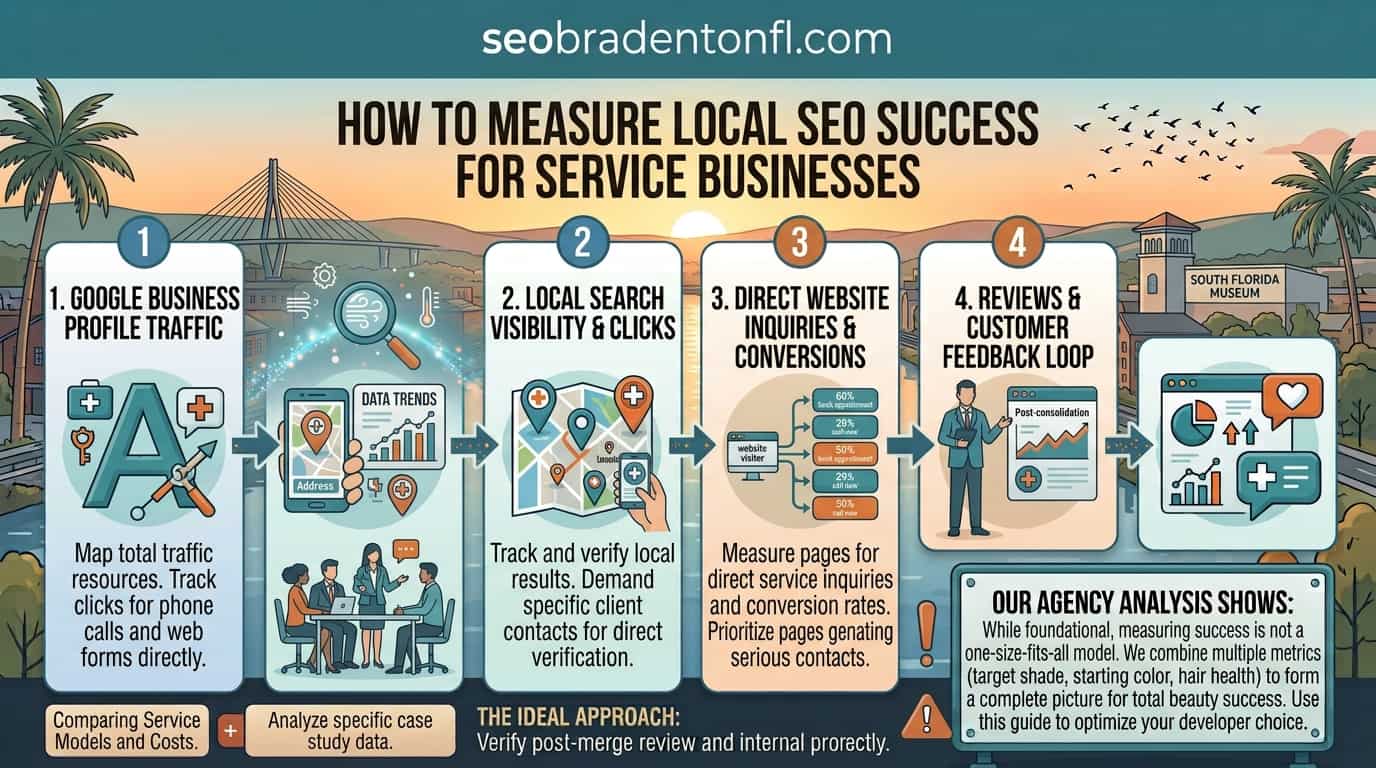
Understanding how to measure local SEO success requires looking beyond rankings and total website traffic. A local service business should measure whether organic search places it in front of relevant customers and whether those visitors become phone calls, form submissions, appointments or qualified leads.
Rankings, impressions and traffic remain useful diagnostic metrics. However, they should be connected with commercial outcomes. A campaign that produces thousands of informational visits but no relevant inquiries may be less valuable than one generating a smaller number of visits from people actively seeking a local service.
The strongest measurement model follows the customer’s journey from search visibility to lead quality and, where possible, completed revenue.
Direct Answer
Local SEO success should be measured across five levels:
- Search visibility: Is the business appearing for relevant local searches?
- Search engagement: Are potential customers clicking its listings?
- Website behavior: Are visitors reaching and using important service pages?
- Lead generation: Are organic visitors calling, submitting forms or booking?
- Business outcomes: Are those leads qualified and becoming customers?
No single metric provides the complete answer.
A practical local SEO report should combine:
- Organic search impressions
- Rankings for commercially relevant searches
- Local Pack and Google Maps visibility
- Organic clicks
- Google Business Profile interactions
- Service-page performance
- Phone calls
- Form submissions
- Bookings or quote requests
- Qualified organic leads
- Customers and revenue attributed to organic search
The closer a metric is to revenue, the more commercially meaningful it becomes. Earlier metrics still matter because they help explain why leads increased, declined or remained unchanged.
Why Rankings Alone Are Not Enough
Rankings are useful because they show whether a website is becoming more visible. However, a ranking report can create a misleading impression when it lacks context.
A business might rank first for:
- Its own name
- A search with almost no demand
- An informational topic
- A location it does not serve
- A service it does not provide
- A query that generates no clicks
At the same time, it might remain nearly invisible for the searches customers use when they are ready to contact a provider.
Rankings should therefore be evaluated according to:
- Search intent
- Geographic relevance
- Service relevance
- Search demand
- The page appearing in the results
- Click-through rate
- Lead generation
- Movement over a meaningful period
A smaller improvement for a valuable commercial search may matter more than first-place rankings for several irrelevant phrases.
Start With Clear Business Objectives
Measurement should begin with the business result the campaign is intended to support.
Common local service business objectives include:
- Increasing qualified phone calls
- Generating more quote requests
- Booking additional appointments
- Increasing demand for a particular service
- Reaching customers in a priority location
- Reducing reliance on paid advertising
- Improving the quality of website leads
- Increasing revenue from organic search
Without a defined objective, an SEO report can become a collection of unrelated numbers.
For example, if a Bradenton roofing company wants more roof-replacement inquiries, the campaign should not be judged primarily by traffic to articles about minor DIY repairs. The report should examine visibility and conversions associated with relevant roofing services.
Objectives should also be specific enough to guide page priorities. “Increase traffic” is not as useful as “increase qualified inquiries for landscaping projects in Bradenton and surrounding service areas.”
1. Measure Commercial Search Visibility
Search visibility shows whether the website appears when potential customers search for relevant services.
Useful visibility metrics include:
- Impressions in Google Search Console
- Average position for priority queries
- Number of commercially relevant queries
- Visibility of important service pages
- Local Pack appearances
- Google Maps visibility
- Visibility across the genuine service area
- Non-branded search visibility
The analysis should separate branded and non-branded searches.
Branded searches
Branded searches contain the business name. They usually come from people who already know the company or encountered it elsewhere.
Growth in branded demand can be positive, but it does not necessarily show that SEO is reaching new customers.
Non-branded searches
Non-branded searches describe a service, need or problem without naming the business.
Examples might include:
- Emergency plumber near me
- Lawn care company in Bradenton
- Roof repair Bradenton
- Pest control for termites
- Local HVAC repair
These searches generally provide better evidence that the business is being discovered by potential new customers.
A report should show whether visibility is increasing for searches that genuinely match the company’s services.
2. Measure Local Pack and Google Maps Visibility
A local service business may appear in:
- Standard organic results
- The Local Pack
- Google Maps
- Its Google Business Profile
- Localized mobile results
These placements should not be treated as one identical ranking.
Local visibility can change according to:
- The searcher’s location
- The business address
- Service-area relevance
- Google Business Profile categories
- Reviews
- Website relevance
- Local authority
- Competition
- Search wording
A single ranking check from one location does not describe visibility across the complete service area.
A better approach is to monitor important searches from several relevant points while checking:
- Local Pack presence
- Map position
- Competitors appearing nearby
- Differences between neighborhoods
- Changes over time
- Visibility for individual services
Google Business Profile performance should also be reviewed for interactions such as:
- Website clicks
- Calls
- Direction requests
- Messages, where enabled
- Bookings, where enabled
These interactions provide useful evidence, although they should be interpreted carefully. A direction request, for example, is an action rather than confirmed revenue.
3. Measure Organic Clicks and Click-Through Rate
Impressions show that a result appeared. Clicks show that someone selected it.
Google Search Console can reveal:
- Queries producing clicks
- Pages receiving clicks
- Click-through rate
- Changes in impressions
- Changes in average position
- Differences between devices
- Geographic performance
Click-through rate can help identify pages that are visible but failing to attract searchers.
A low click-through rate may result from:
- An unclear title
- An unappealing description
- Weak relevance to the search
- A low position
- Stronger competitor listings
- Reviews or map results dominating the page
- The query being answered directly in search results
- A mismatch between the page and the searcher’s need
CTR should not be evaluated without considering position and query type. A result at position eight will normally receive fewer clicks than one at position two.
The agency should examine specific query-and-page combinations rather than making sitewide changes based only on an average CTR.
4. Measure Priority Service-Page Performance
Not all organic landing pages carry equal commercial importance.
A local service business should identify its priority pages, which may include:
- Main service pages
- High-value service pages
- Location pages
- Emergency-service pages
- Appointment pages
- Quote-request pages
- Contact pages
For each priority page, measure:
- Organic impressions
- Organic clicks
- Queries producing visibility
- Landing-page sessions
- Engagement
- Calls
- Form submissions
- Bookings
- Assisted conversions
- Lead quality
A page may receive limited traffic while producing a high proportion of qualified inquiries. Another page may attract substantial traffic without contributing to the sales process.
The goal is not necessarily to make every page the most visited page. It is to make each page fulfill its intended purpose.
5. Track Phone Calls Correctly
Phone calls are frequently one of the most important conversions for local service businesses.
Call measurement may include:
- Clicks on phone numbers
- Calls generated from the website
- Calls from Google Business Profile
- Call duration
- First-time callers
- Answered and missed calls
- Qualified calls
- Booked appointments or estimates
A click on a telephone link does not confirm that a call connected. When call volume is commercially important, call-tracking software can provide more reliable information.
However, call tracking should be configured carefully. The business’s real phone number should remain consistent in important directory listings, while dynamic number insertion can be used on the website to attribute calls without creating unnecessary local citation inconsistencies.
Call duration can help filter accidental or very short calls, but it does not establish lead quality by itself. A brief call could still be valuable, while a long call may be unrelated.
Where possible, calls should be reviewed or categorized as:
- Qualified lead
- Existing customer
- Supplier
- Recruitment inquiry
- Spam
- Wrong number
- Unanswered call
- Booked customer
6. Track Forms, Bookings and Other Conversions
Every important contact method should be measured.
These may include:
- Contact-form submissions
- Quote requests
- Appointment bookings
- Online purchases
- Live-chat conversations
- Email-link clicks
- WhatsApp inquiries
- Downloads
- Account registrations
Tracking should confirm successful completion rather than simply recording a visit to the page containing the form.
For example, measuring every visit to the contact page as a lead will exaggerate performance. A proper event should record the successful submission or completed booking.
Test the tracking regularly. Website updates, plugin changes, form replacements and consent settings can cause conversions to stop recording.
A business receiving traffic without inquiries should investigate both tracking and conversion problems. This guide explains why a website may not be generating leads.
7. Measure Lead Quality, Not Just Lead Quantity
SEO can increase inquiries without improving business performance if those inquiries are unsuitable.
Lead quality should be assessed using criteria such as:
- Requested service
- Customer location
- Project value
- Urgency
- Budget
- Eligibility
- Appointment attendance
- Quote acceptance
- Sales outcome
A campaign generating 20 irrelevant inquiries may be less valuable than one generating five suitable prospects.
This is especially important for businesses with limited service areas. Inquiries from outside the service area may indicate that location targeting, page wording or Google Business Profile settings need improvement.
Lead-quality information usually comes from the business’s CRM, call records or sales team rather than Google Analytics alone.
The SEO provider and business should agree on what constitutes a qualified lead.
8. Connect SEO Leads With Customers and Revenue
The strongest measurement connects marketing activity with commercial outcomes.
Where the sales process permits, track:
- Qualified leads
- Appointments
- Estimates issued
- Sales opportunities
- New customers
- Revenue
- Average customer value
- Cost per qualified lead
- Customer acquisition cost
- Return on investment
This requires cooperation between marketing and sales.
A website analytics platform may show that a form was submitted, but it cannot automatically determine whether that person became a customer unless the CRM or sales process sends that information back.
For local service businesses with offline sales, a simple lead-source field can help. Staff can record whether a customer came from:
- Organic search
- Google Business Profile
- Google Ads
- Referral
- Social media
- Existing customer
- Another source
Attribution will never be perfect. A customer may see the business in Maps, return through a branded search and later call from the website. The objective is to build a reasonable measurement model rather than pretend every sale has one isolated source.
9. Evaluate Supporting Content Properly
Not every article should be judged by direct form submissions.
Supporting content can contribute by:
- Answering early-stage questions
- Introducing potential customers to the business
- Strengthening internal links
- Supporting important service pages
- Earning relevant links
- Demonstrating expertise
- Assisting later conversions
- Increasing visibility for related searches
Measure supporting content using:
- Relevant impressions
- Organic clicks
- Engagement
- Internal-link clicks
- Assisted conversions
- Links earned
- Movement of associated service pages
An article explaining how to evaluate an SEO provider may not produce an immediate inquiry from every reader. It can still help a business compare providers and move toward a decision.
Related resources include the guide covering questions to ask an SEO agency and the framework for verifying an SEO case study.
10. Compare Performance Over Suitable Periods
SEO results should not be judged from one day to the next.
Useful comparisons may include:
- Month over month
- Quarter over quarter
- Year over year
- Before and after a substantial change
- Rolling 28-day or 90-day periods
The appropriate period depends on:
- Search volume
- Seasonality
- Website size
- Competitive conditions
- Type of change
- Sales cycle
- Available data
Year-over-year comparison is often useful for seasonal businesses. Month-over-month data can be misleading when demand naturally rises or falls during certain periods.
Reports should annotate significant events, such as:
- Website migrations
- Redesigns
- Tracking changes
- New service launches
- Business closures
- Major promotions
- Algorithm updates
- Technical problems
Without this context, performance changes may be attributed to the wrong cause.
Leading and Lagging SEO Metrics
SEO metrics can be divided into leading and lagging indicators.
Leading indicators
These appear earlier and suggest whether progress may be developing:
- Improved crawling and indexing
- More non-branded impressions
- Better visibility for priority searches
- Movement toward page one
- Increased Local Pack coverage
- Improved click-through rate
- More visits to service pages
Lagging indicators
These appear later and are closer to business outcomes:
- Qualified calls
- Form submissions
- Appointments
- Sales opportunities
- New customers
- Revenue
- Return on investment
A campaign may improve leading indicators before generating a measurable increase in sales. That does not prove future success, but it helps determine whether the work is moving in the intended direction.
If visibility improves but clicks do not, investigate search-result presentation and intent. If clicks increase but leads do not, examine page quality and conversion pathways. If leads increase but sales do not, review lead quality and the sales process.
A Practical Local SEO Measurement Framework
| Measurement level | Core question | Example metrics |
|---|---|---|
| Visibility | Are relevant customers seeing the business? | Impressions, rankings, Local Pack coverage |
| Engagement | Are searchers selecting the result? | Organic clicks, CTR, profile interactions |
| Website behavior | Are visitors reaching useful pages? | Service-page sessions, engagement, pathways |
| Conversion | Are visitors contacting the business? | Calls, forms, bookings, chats |
| Lead quality | Are inquiries commercially relevant? | Qualified leads, location and service fit |
| Revenue | Are leads becoming customers? | Sales, revenue, acquisition cost and ROI |
This framework prevents a report from presenting rankings as the final outcome.
What Should a Monthly Local SEO Report Include?
A useful report should show:
- Work completed
- Important technical findings
- Visibility for priority services
- Local Pack and Maps performance
- Organic clicks and landing pages
- Phone calls and form submissions
- Qualified-lead information
- Significant performance changes
- Problems requiring attention
- Priorities for the next period
It should also explain what the numbers mean.
A report that contains dozens of charts but no interpretation does not help the business decide what to do next.
The provider should connect each major action with a reason and an appropriate measure of progress.
Common Measurement Mistakes
Avoid these mistakes:
- Treating every ranking as equally valuable
- Reporting total traffic without separating organic traffic
- Combining branded and non-branded searches
- Counting contact-page visits as leads
- Ignoring phone calls
- Failing to test form tracking
- Measuring lead quantity without lead quality
- Checking Maps visibility from only one location
- Comparing seasonal months without context
- Claiming every conversion came from the last recorded click
- Focusing on sitewide averages instead of priority pages
- Reporting activity instead of outcomes
Measurement should produce decisions. If a metric never changes what the business or agency does, reconsider why it is being reported.
How Long Should Measurement Continue Before Judging SEO?
There is no universal period because websites begin from different positions.
Evaluation depends on:
- Existing authority
- Technical condition
- Competition
- Search demand
- Website history
- Scope of work
- Speed of implementation
- Frequency of crawling
- Sales cycle
Early technical and visibility signals may appear before meaningful lead growth. New websites and highly competitive markets can require considerably more time.
The campaign should establish expectations for both early indicators and longer-term commercial outcomes. It should then evaluate progress at agreed intervals rather than postponing accountability indefinitely.
Final Answer
To understand how to measure local SEO success, follow the complete path from visibility to revenue.
Track whether the business:
- Appears for relevant local searches
- Earns clicks from potential customers
- Sends visitors to appropriate service pages
- Generates phone calls, forms and bookings
- Attracts qualified prospects
- Converts those prospects into customers
Rankings, traffic and impressions explain what is happening in search. Qualified leads, customers and revenue show whether that visibility has commercial value.
Businesses seeking to improve and measure their local search performance can review SEO services for Bradenton businesses. The measurement plan should be agreed upon before work begins so both the business and provider understand what success means.