

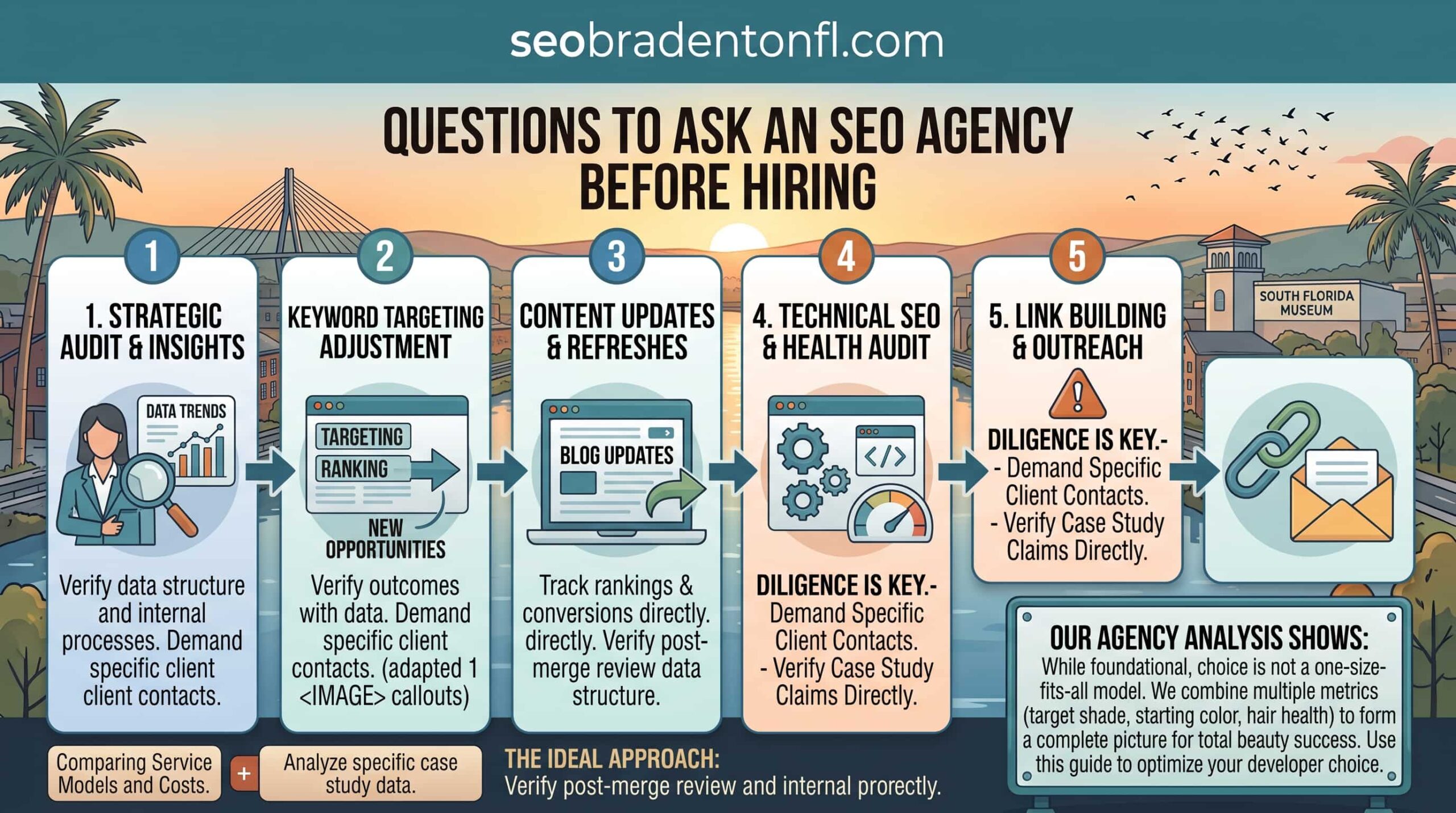
The most important questions to ask an SEO agency concern how it selects priorities, measures results, communicates progress and connects search visibility with business outcomes. A provider should be able to explain its decisions clearly without promising guaranteed rankings or hiding its work behind technical language.
For a Bradenton business, local knowledge can be helpful, but location alone does not establish competence. The agency should also understand search intent, website structure, Google Business Profile visibility, conversion tracking and the commercial value of different searches.
Before signing an agreement, ask for specific explanations rather than accepting broad promises such as “more traffic,” “better rankings” or “complete optimization.”
Direct Answer
Before hiring an SEO provider, a Bradenton business should ask:
- What will you examine before recommending a strategy?
- How will you identify our most valuable search opportunities?
- Which pages will you prioritize?
- What work will you complete each month?
- How will you measure leads from organic search?
- How will you approach local search and Google Maps?
- Can you explain your previous results with supporting evidence?
- Who will complete the work?
- How will changes be approved?
- Who owns the website, content and accounts?
- How and when will you report progress?
- What happens if the strategy is not producing the expected signals?
- What methods will you use to acquire links?
- How do you prevent competing or duplicate pages?
- What is included in the price?
- What happens when the agreement ends?
The quality of the answers matters more than whether the provider uses a particular set of tools or promises a particular number of deliverables.
1. What Will You Examine Before Recommending a Strategy?
An SEO provider should not recommend an identical plan for every business.
Before defining the work, the provider should review areas such as:
- Existing organic visibility
- Important products or services
- Geographic service area
- Website structure
- Technical condition
- Current rankings and search queries
- Google Business Profile
- Competitors in organic and local results
- Existing content
- Internal links
- Backlink profile
- Lead-tracking setup
- Conversion pathways
A roofing company, medical practice, landscaping business and ecommerce store will not require the same strategy. Their customers search differently, their sales processes differ and their websites serve different purposes.
A provider that proposes a package before examining the website may be selling predetermined production rather than a strategy based on the business.
Businesses that need a structured examination of their current website can begin with professional SEO audit services.
2. How Will You Identify Our Most Valuable Search Opportunities?
Keyword research should consider more than search volume.
A useful opportunity generally combines:
- Relevance to a real service
- Appropriate search intent
- Geographic relevance
- Realistic ranking potential
- Commercial value
- A suitable destination page
- A clear next action for the visitor
A keyword with thousands of searches may produce little value if the searcher is looking for general information rather than a local provider. A lower-volume search may be more valuable when it reflects an immediate need for a service.
Ask the provider to explain how it separates:
- Informational searches
- Service searches
- Location-based searches
- Brand searches
- Comparison searches
- Urgent or high-intent searches
The provider should also explain which existing page should own each important topic. Creating a new page for every keyword variation can produce duplicate content and internal competition.
3. Which Pages Will You Prioritize?
An agency should be able to explain why certain pages deserve attention first.
Priority pages may include those that:
- Represent important services
- Generate substantial impressions but few clicks
- Rank close to the first page
- Receive traffic without producing leads
- Lack necessary service information
- Have weak internal-link support
- Compete with another page on the website
- Target valuable searches with the wrong intent
- Serve strategically important locations
The answer should not automatically be “we will publish more blogs.”
Supporting articles can strengthen topical coverage and answer early-stage questions, but they should connect with suitable service pages. In many cases, improving an existing commercial page may produce more value than publishing several unrelated articles.
Ask the agency to show how proposed content will support the rest of the website.
4. What Work Will You Complete Each Month?
The provider should distinguish between recurring oversight and flexible implementation.
Recurring work may include:
- Search Console monitoring
- Analytics review
- Ranking analysis
- Technical checks
- Lead and conversion review
- Reporting
- Communication
- Planning
Implementation may change according to current priorities. One month might focus on technical corrections, while another might involve service-page improvements, internal links, content consolidation or local visibility.
Be cautious if the provider promises exactly the same outputs every month without explaining why the website will need them.
Defined deliverables provide accountability, but the work should remain responsive to evidence.
5. How Will You Measure Leads From Organic Search?
Traffic alone does not show whether SEO is helping the business.
Ask how the provider will measure valuable actions such as:
- Contact-form submissions
- Phone calls
- Appointment requests
- Quote requests
- Online purchases
- Bookings
- Visits to important service pages
- Clicks for directions
- Qualified leads recorded in a CRM
The measurement plan should distinguish between organic search, paid advertising, direct visits, referrals and other sources where possible.
The provider should also check whether forms, phone links and calls to action work correctly. Improving rankings will have limited commercial value if visitors cannot easily contact the business.
If a website receives visitors but few inquiries, review the reasons a website may not be generating leads.
6. How Will You Approach Local Search and Google Maps?
For a business serving Bradenton and surrounding areas, local search may be as important as conventional organic rankings.
Ask whether the provider will review:
- Google Business Profile categories
- Business name, address and phone consistency
- Service information
- Opening hours
- Review acquisition
- Review responses
- Photos
- Local citations
- Location relevance
- Service-area accuracy
- Local landing pages
- Links and mentions from relevant organizations
- Local Pack visibility
The agency should not create misleading location pages for areas the business does not genuinely serve. Each page should provide useful, location-specific information rather than swapping city names in the same template.
Local SEO should connect the website, Google Business Profile and real-world business information.
7. Can You Explain Previous Results With Supporting Evidence?
A case study should explain more than a percentage increase.
Ask the provider:
- What was the client’s starting position?
- What period does the comparison cover?
- Which pages or searches improved?
- Was the traffic branded or non-branded?
- Did the campaign produce qualified leads?
- What work caused or contributed to the change?
- Were there seasonal factors?
- Did paid advertising run during the same period?
- Can the business or website be independently verified?
- Is the agency authorized to present the result?
A graph can be genuine while still providing an incomplete picture. For example, a large percentage increase can come from a very small starting number.
Use the complete guide on how to verify an SEO case study before relying on performance claims.
8. Who Will Actually Complete the Work?
The person selling the service may not be the person managing the campaign.
Ask:
- Who will be the main contact?
- Who handles technical work?
- Who writes or edits content?
- Who completes website changes?
- Is any work outsourced?
- Who checks the work before publication?
- Does the team have access to a developer?
- Who reviews performance and selects priorities?
- How quickly will questions be answered?
Outsourcing is not automatically a problem. The concern is whether responsibility, quality control and communication are clear.
The provider should also identify work requiring input from the business, such as service details, legal approval, subject-matter review or access to website systems.
9. How Will Website Changes Be Approved?
SEO sometimes requires changes to titles, page content, navigation, internal links, technical settings and page structure.
Ask whether the agency:
- Makes changes directly
- Submits recommendations for approval
- Works with the existing developer
- Keeps a record of changes
- Tests changes before deployment
- Maintains backups
- Uses a staging website for substantial work
- Has a rollback procedure
The right process depends on the business, but it should be agreed upon before access is granted.
Highly regulated businesses may also require professional or legal review before publishing certain content.
10. Who Owns the Website, Content and Accounts?
The business should retain appropriate ownership and access.
Confirm ownership of:
- Domain registration
- Website hosting
- WordPress administrator access
- Google Business Profile
- Google Search Console
- Google Analytics
- Google Tag Manager
- Call-tracking accounts
- Advertising accounts
- Written content
- Images and creative assets
- Reporting dashboards
The agency may need access to these systems, but the client should not become dependent on the provider for permanent control of essential business assets.
Ask what will happen to accounts, content and tracking systems if the relationship ends.
11. How and When Will You Report Progress?
A useful report should explain:
- What work was completed
- Why that work was selected
- Changes in organic visibility
- Performance of priority pages
- Important search-query movements
- Leads or conversions from organic search
- Technical issues discovered
- Work awaiting approval
- Current limitations
- Priorities for the following period
Ask for a sample report with confidential client information removed.
Be cautious if reporting focuses only on total keyword counts or website traffic. Those figures can increase without generating relevant business.
The provider should translate performance data into clear decisions and actions.
12. What Happens If the Strategy Is Not Working?
SEO does not always progress according to the original plan.
A responsible provider should explain:
- Which early signals it expects
- When it will evaluate those signals
- How it will investigate declines
- When it will revise page targeting
- How it handles incorrect assumptions
- Whether it updates or consolidates weak content
- How it reacts to technical problems
- How it changes priorities when business needs change
The agency should not respond to every short-term fluctuation with immediate changes. However, it should have a diagnostic process for persistent underperformance.
Ask for an example of a campaign where the initial approach had to change and what the provider learned.
13. What Link-Building Methods Will You Use?
Links can help search engines discover and evaluate pages, but poor-quality link building can introduce unnecessary risk.
Ask whether the provider uses:
- Digital public relations
- Relevant editorial outreach
- Local organizations
- Business associations
- Industry publications
- Supplier or partner relationships
- Useful original resources
- Legitimate business directories
- Competitor link-gap analysis
Ask directly whether it purchases links, uses private blog networks, automates mass outreach or guarantees a fixed number of backlinks.
A report should explain the relevance and context of acquired links, not merely list a quantity.
The provider should be willing to say when a proposed link is not worth pursuing.
14. How Do You Prevent Keyword Cannibalization?
Keyword cannibalization occurs when multiple pages compete for the same or very similar search intent.
Ask how the agency decides:
- Which page owns a keyword group
- Whether a new page is necessary
- When existing content should be updated
- When similar pages should be consolidated
- Which URL should receive internal links
- Whether old pages need redirects
- How service and supporting content remain distinct
A clear page-ownership plan is particularly important when a website contains several similar services or location pages.
The agency should search the existing website before recommending new content.
15. What Is Included in the Price?
Request a clear written scope.
It should explain:
- Services included
- Expected monthly capacity
- Reporting frequency
- Meeting frequency
- Content allowances
- Technical implementation
- Developer involvement
- Link-building activity
- Local SEO work
- Tracking setup
- Additional charges
- Contract length
- Cancellation terms
Ask whether third-party costs are included. These could include call tracking, content production, development, stock images, outreach, directory fees or specialist tools.
A lower price is not necessarily less expensive if the agreement consists mainly of recommendations that no one implements.
16. What Happens When the Agreement Ends?
Before signing, ask:
- How much notice is required?
- Will all account access remain available?
- Will tracking continue to operate?
- Who retains published content?
- Will the provider supply a final report?
- Will unfinished work be documented?
- Are there any transfer fees?
- Will the agency remove anything from the website?
- Will redirects or technical changes remain in place?
A professional offboarding process protects both parties and prevents disruption to the website.
Questions That Should Raise Concern
Certain answers deserve closer examination.
Warning signs include:
- Guaranteed first-place rankings
- A strategy proposed without reviewing the website
- Refusal to explain link-building methods
- Reports based only on keyword counts
- No lead or conversion measurement
- Identical deliverables for every client
- Ownership of essential accounts retained by the agency
- Large traffic claims without commercial context
- New pages recommended without checking existing content
- Unclear cancellation or transfer terms
- Claims that competitors can be removed from Google
- Promises of immediate results
- Unwillingness to document completed work
No agency can control Google’s results. It can control the quality of its research, implementation, monitoring and communication.
How Should a Bradenton Business Compare Providers?
Use a consistent evaluation framework rather than choosing entirely on price or presentation.
| Evaluation area | What to examine |
|---|---|
| Diagnosis | Does the provider understand the website’s current problems? |
| Strategy | Are priorities connected to business objectives? |
| Local knowledge | Does it understand Bradenton and the genuine service area? |
| Implementation | Who completes the recommended work? |
| Measurement | Are leads and qualified actions tracked? |
| Evidence | Can past performance claims be examined? |
| Communication | Are reports and responsibilities clear? |
| Ownership | Does the business retain control of essential assets? |
| Risk | Are link building and technical changes handled responsibly? |
| Terms | Are pricing, cancellation and offboarding documented? |
Businesses should also decide which working model suits their resources. Compare an SEO agency, freelancer and in-house hire before evaluating individual providers.
Should the Cheapest SEO Provider Be Selected?
Price should be evaluated in relation to the work, expertise and implementation included.
A less expensive provider may be suitable when:
- The website is small
- The competitive environment is limited
- Internal staff can implement recommendations
- The required work is narrowly defined
- The business has modest geographic coverage
A larger investment may be justified when:
- The website has serious technical problems
- Several locations or services are involved
- The market is highly competitive
- Extensive development is required
- Content needs expert review
- Lead tracking is currently unreliable
- The business depends heavily on organic search
The goal is not to purchase the largest number of tasks. It is to direct the available budget toward the work most likely to improve relevant visibility and generate qualified opportunities.
Final Checklist Before Signing
Before appointing a provider, confirm that you understand:
- The campaign’s objectives
- The pages and services being prioritized
- The initial problems to be addressed
- The expected work
- The reporting process
- The lead-tracking setup
- The people responsible for implementation
- The approval process
- Account and content ownership
- Link-building methods
- Pricing and additional costs
- Contract and cancellation terms
- The offboarding procedure
Keep the agency’s answers in writing. These answers can later be used to evaluate whether the agreed process is being followed.
Final Answer
The best questions to ask an SEO agency reveal how it thinks, not merely what it sells.
A reliable provider should be able to explain:
- What it found
- Why particular work is necessary
- Which pages it will prioritize
- How it will measure meaningful results
- Who will implement each change
- How it will adapt when evidence changes
- What the business will own
- What the agreement includes
Bradenton businesses considering professional support can review SEO Bradenton FL to understand how search visibility, website improvements and local relevance can be connected within one campaign.
Do not select a provider solely because it promises the fastest results, the most backlinks or the largest number of articles. Select one that demonstrates a clear diagnostic process, responsible implementation and transparent measurement.