

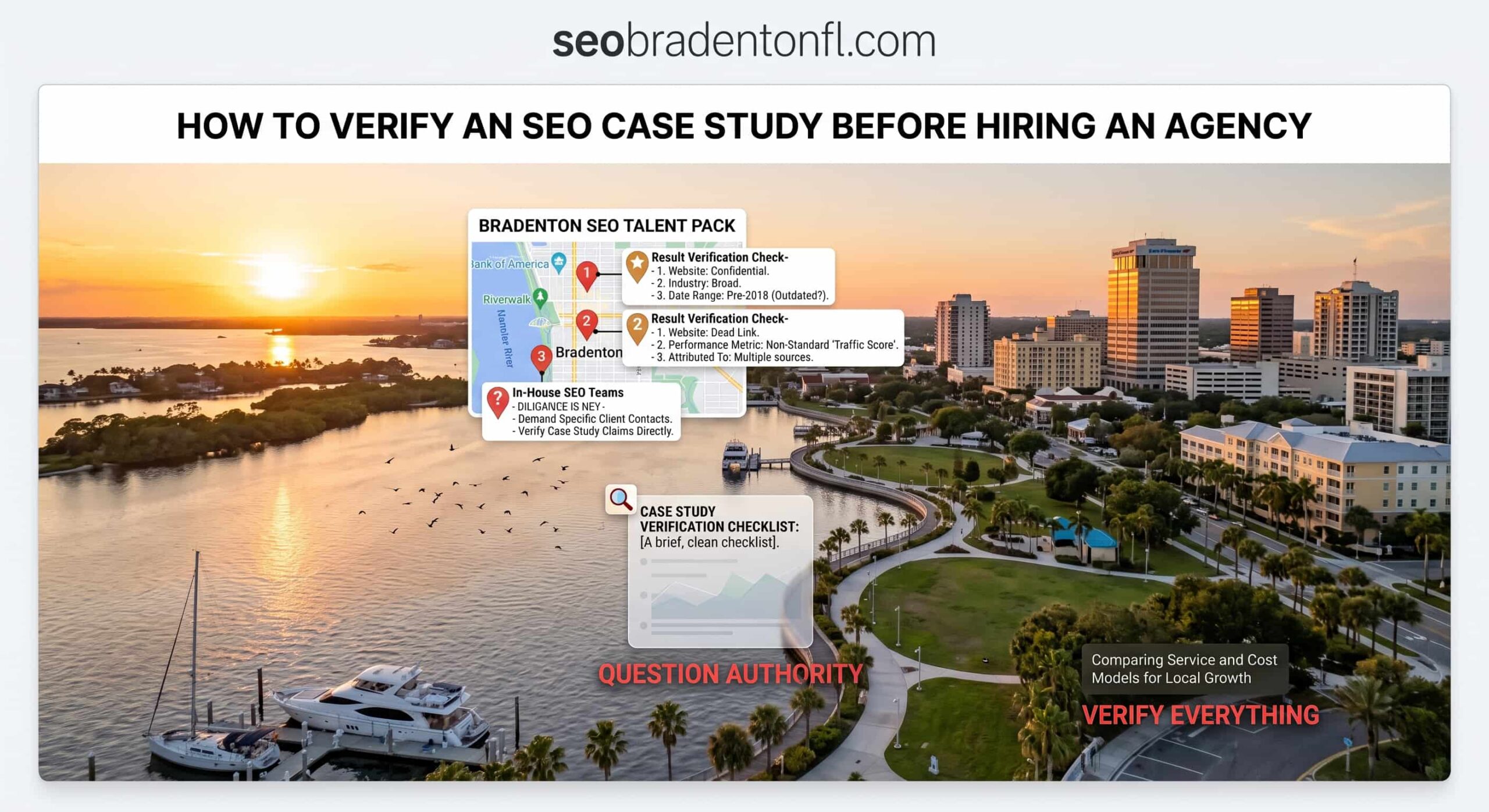
To understand how to verify an SEO case study, look beyond the headline percentage. Check the starting position, reporting period, source of the data, work completed and effect on leads or sales. You should also confirm that the featured business resembles yours closely enough for the results to be relevant.
A case study can provide useful evidence that an SEO provider has solved a particular problem. However, screenshots and growth percentages can be presented without enough context to show what actually happened.
Before selecting an SEO company in Bradenton, use the following due-diligence framework to determine whether a case study demonstrates meaningful experience or merely creates a favorable impression.
What Does a Credible SEO Case Study Need to Prove?
A useful case study should establish five things:
- The client or business situation was genuine.
- The reported performance change occurred.
- SEO contributed to that change.
- The provider performed identifiable work.
- The experience is relevant to the service you require.
A case study does not need to reveal confidential client information. It should still contain enough evidence to let a prospective client understand the original problem, the strategy used and the outcome.
Be cautious when the entire case study consists of a traffic graph, a percentage increase and a statement that the agency achieved exceptional growth.
Those elements may be accurate, but they do not explain whether the campaign generated commercially useful results.
How to Verify an SEO Case Study in 10 Steps
1. Identify the Starting Point
Every performance claim needs a baseline.
Suppose a case study reports a 300 percent increase in organic traffic. That sounds impressive, but the meaning changes depending on whether traffic increased:
- From 10 visits to 40 visits
- From 1,000 visits to 4,000 visits
- After a previous website tracking failure
- Following the launch of an entirely new website
- During a predictable seasonal increase
- After traffic had previously collapsed
Ask what the website’s position was before the campaign started.
A credible case study should explain:
- The initial level of organic traffic
- Existing rankings or visibility
- The condition of the website
- Whether conversion tracking was working
- The main commercial problem
- Previous SEO work or penalties
- The competitive environment
Without a defined baseline, a percentage can easily exaggerate a relatively small change.
2. Check the Reporting Period
SEO results should always be connected to specific dates.
Look for a clear campaign start date and the period used for comparison. Statements such as “traffic increased dramatically” or “rankings improved quickly” are difficult to assess without a timeline.
The comparison method matters too.
Month-over-month growth may be misleading for a seasonal business. A roofing company might receive more searches during storm season, while an air-conditioning company could experience a predictable increase during hot weather.
Useful comparisons may include:
- The campaign period against the previous period
- The same months in the previous year
- Performance before and after a documented website change
- Progress from the campaign starting point
- A trend shown across several months
Check whether the case study selected an unusually weak month as its baseline. The results may be real while still overstating the campaign’s normal impact.
3. Look for Evidence From Appropriate Platforms
The evidence should come from platforms capable of measuring the reported result.
Different systems answer different questions:
| Claim | Appropriate evidence |
|---|---|
| Google Search visibility increased | Google Search Console |
| Organic website sessions increased | Google Analytics |
| Form submissions increased | Analytics events, CRM or form records |
| Calls increased | Call-tracking platform |
| Ecommerce revenue increased | Ecommerce analytics and transaction data |
| Map visibility improved | Google Business Profile data or a local rank-tracking grid |
| Target keyword rankings improved | Search Console and a reliable rank tracker |
A graph without a platform name, date range or measurement definition provides limited verification.
Screenshots should ideally show enough context to identify:
- The reporting platform
- The selected date range
- The metric being displayed
- The comparison period
- Any filters applied
- Whether the figures relate to organic search
The agency may need to conceal the client’s identity or revenue. That does not prevent it from explaining how the evidence was collected.
4. Distinguish Impressions, Traffic and Conversions
These metrics represent different stages of search performance.
An impression means a result was displayed in search. A click means someone visited the website. A conversion means the visitor completed a defined action, such as calling, submitting a form, booking an appointment or making a purchase.
A website can gain impressions without gaining clicks. It can gain traffic without generating additional leads. It can also generate more enquiries without increasing total traffic if commercially important pages improve.
Ask which outcome the case study actually demonstrates:
- Greater search visibility
- More organic visits
- More qualified enquiries
- More booked appointments
- More sales
- Higher organic revenue
- A lower cost per acquired customer
Traffic growth can be valuable, but it should not automatically be described as business growth.
5. Check Whether Branded Traffic Was Separated
Branded searches include the company’s name, product names or other terms directly associated with the business.
These searches can increase because of offline advertising, social media exposure, public relations, referrals or an established reputation. SEO may help the website capture this demand, but it may not have created the demand.
Non-branded searches are often more useful when evaluating whether SEO expanded the business’s visibility among people who were not already looking for it.
Ask whether the results include:
- Branded search traffic
- Non-branded search traffic
- Both categories combined
- Searches unrelated to the company’s services
A credible case study should not hide behind a large increase in branded demand when its central claim concerns new customer acquisition through SEO.
6. Examine Which Pages Produced the Growth
Sitewide traffic can conceal where the improvement occurred.
A case study should identify whether growth came from:
- Service pages
- Product or category pages
- Location pages
- Blog articles
- The homepage
- Google Business Profile
- Irrelevant informational content
The commercial meaning differs considerably.
An article may generate thousands of visits from readers outside the company’s service area. A service page may attract fewer visits while producing valuable calls and enquiries.
Ask which landing pages improved and whether those pages were connected to the client’s commercial objectives.
If your own website receives traffic but produces few leads, the problem may involve page intent, trust, usability or conversion tracking. This is explored further in our guide to why a website may not generate leads.
7. Ask What Work Was Actually Completed
Results should be connected to identifiable actions.
A detailed case study might describe work such as:
- Correcting indexing problems
- Reorganizing the website structure
- Improving service pages
- Creating useful location pages
- Consolidating competing content
- Strengthening internal links
- Improving titles and search snippets
- Adding conversion tracking
- Improving Google Business Profile information
- Earning relevant links
- Resolving technical performance problems
The agency should not need to reveal every part of its process. It should explain enough to show that the strategy responded to the client’s specific problems.
Generic statements such as “we optimized the website” do not clarify what changed or why it mattered.
If the campaign began with a technical investigation, ask what the SEO audit discovered and which recommendations were implemented.
8. Test Whether SEO Was Responsible for the Result
SEO campaigns do not operate in isolation.
Performance can be affected by:
- Paid advertising
- A website redesign
- A new product launch
- Public relations coverage
- Changes in pricing
- Increased offline demand
- Seasonal trends
- Competitor closures
- Expanded service areas
- Changes to conversion tracking
- Search engine updates
This does not invalidate the case study. It means the provider should acknowledge other factors that may have contributed to the result.
For example, a rise in recorded enquiries may follow the installation of accurate form and call tracking. That represents an improvement in measurement, but it does not necessarily mean the company suddenly received the same percentage increase in new enquiries.
Ask what changed outside the SEO campaign during the reporting period.
9. Decide Whether the Client Is Comparable to Your Business
An impressive result is not automatically relevant.
Consider whether the case-study client had similar characteristics:
- Industry
- Location
- Business model
- Website size
- Starting authority
- Competition
- Available budget
- Length of campaign
- Internal resources
- Number of service areas
- Regulatory restrictions
- Sales cycle
A national ecommerce campaign does not necessarily demonstrate expertise in local lead generation. Ranking an established website with thousands of links is different from developing visibility for a new local business.
For a Bradenton service company, a relevant case study would ideally demonstrate experience with local intent, service pages, map visibility, lead tracking and geographically limited competition.
The goal is not to find a business identical to yours. It is to determine whether the provider has solved a sufficiently similar problem.
10. Ask Whether the Result Was Maintained
A short performance spike may not indicate lasting improvement.
Ask what happened after the headline result:
- Did traffic remain higher?
- Did the improved pages retain their visibility?
- Did leads continue?
- Was growth dependent on constant content production?
- Did rankings decline after a search update?
- Is the business still working with the provider?
- Were any risky tactics used?
A responsible agency cannot guarantee that rankings will remain unchanged. It should still be able to discuss the durability of its work and any subsequent changes.
Longer-term evidence is particularly valuable when a case study claims that the campaign created sustainable organic growth.
A Simple SEO Case Study Verification Scorecard
Use this scorecard when comparing case studies from different providers. Give one point for each question that can be answered clearly.
| Verification question | Yes or no |
|---|---|
| Is the business and its original problem described? | |
| Is there a clear starting baseline? | |
| Are exact reporting dates provided? | |
| Is the comparison period appropriate? | |
| Is the data source identified? | |
| Are organic search results separated from other channels? | |
| Are impressions, traffic and conversions distinguished? | |
| Are branded and non-branded results explained? | |
| Are the pages responsible for growth identified? | |
| Is the completed SEO work described? | |
| Are other contributing factors acknowledged? | |
| Is the client comparable to your business? | |
| Are limitations or setbacks disclosed? | |
| Is there evidence that the result lasted? | |
| Can the agency answer follow-up questions? |
A high score does not guarantee that an agency is the right choice. It does indicate that the case study contains enough information for meaningful evaluation.
A low score means you should request more context before relying on the result.
Questions to Ask the SEO Provider
Use these questions during an initial consultation:
- What was the client’s starting position?
- Which dates does the case study cover?
- What comparison period did you use?
- Which platform produced the data?
- Were branded searches included?
- Which pages generated the reported improvement?
- Did organic leads or revenue increase?
- How were calls and form submissions tracked?
- What work did your team complete?
- Did the client make other marketing changes?
- What challenges or setbacks occurred?
- How long did it take before measurable progress appeared?
- Were the gains maintained?
- Why is this case study relevant to my business?
- Can you show anonymized supporting evidence?
The quality of the answers matters as much as the case study itself. A credible provider should be comfortable explaining its methodology without claiming that every client will achieve identical results.
Warning Signs in an SEO Case Study
Treat the following as reasons to investigate further:
- No dates or comparison period
- A percentage with no starting figure
- Cropped graphs with no visible data source
- Traffic presented as revenue
- Impressions presented as visits
- Rankings shown for obscure or irrelevant keywords
- No explanation of the work completed
- No mention of the campaign duration
- Results that coincide with a major tracking change
- A case study from an unrelated business model
- Guaranteed replication of another client’s results
- Claims that one tactic caused every improvement
- No discussion of limitations or setbacks
- Refusal to answer reasonable verification questions
One warning sign does not necessarily prove that the case study is false. Several unexplained warning signs should reduce the weight you give it when making a hiring decision.
Can an Anonymous SEO Case Study Still Be Credible?
Yes. Some clients do not permit agencies to disclose their names, revenue or analytics accounts.
An anonymous case study can still be credible if it provides:
- A clear description of the business
- A defined initial problem
- Specific dates
- Labeled data sources
- An explanation of the work
- Relevant before-and-after measurements
- An honest account of limitations
- Anonymized screenshots with sufficient context
Confidentiality should protect the client’s identity. It should not prevent the agency from explaining its methodology.
Should You Contact the Featured Client?
If the client is named and has agreed to act as a reference, a short conversation can provide useful context.
Ask the client:
- Whether the agency completed the work described
- Whether communication was clear
- Whether reports matched business performance
- Whether the campaign generated useful enquiries
- How the agency handled problems
- Whether the client would hire the provider again
Do not assume that every named client is available for unsolicited contact. Ask the SEO provider whether a reference has consented to being approached.
What an SEO Case Study Cannot Prove
Even a well-documented case study cannot guarantee your future results.
It cannot prove that:
- Your website will improve at the same rate
- You will achieve the same rankings
- Google will behave in the same way
- Your competitors will remain inactive
- Your market has identical demand
- The same budget will produce the same outcome
- Every tactic will transfer to your website
A case study demonstrates relevant past experience. It should support a purchasing decision, not replace an assessment of your own website, market and objectives.
Final Due-Diligence Decision
To verify an SEO case study, confirm the baseline, timeline, data source, work completed and commercial outcome. Then investigate whether other marketing activity contributed to the result and whether the featured business is genuinely comparable to yours.
The most convincing case studies do not rely on a spectacular percentage alone. They show a clear business problem, documented actions, appropriate measurements and limitations that the reader can understand.
Use case studies as evidence of problem-solving ability. Before hiring an SEO provider, combine that evidence with an audit of your current position, a clear measurement plan and direct questions about how the proposed strategy will apply to your business.